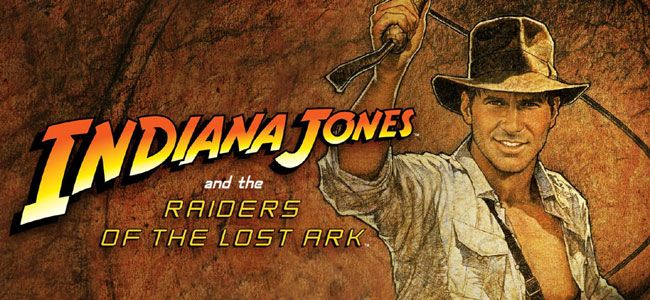
Every frame of
Raiders of the Lost Ark contains an enduring iconography, not only because from
scene to scene the picture surges with nonstop energy and craft, but because
the production embraces a particular classicism balanced between nostalgia and
sheer adventure. An undeniably familiar, reminiscent quality flows from
director Steven Spielberg and producer George Lucas’ brilliantly spun yarn,
from their use of historical and religious imagery to their deliberate
evocation of Saturday matinee serials, all of which form an instant bond
between the audience, film, and memory. This bond is not limited to the past,
however; as much as Raiders of the Lost Ark reconnects the viewer with various
histories, it also transcended those elements in 1981 by creating a bold new
standard for adventure and blockbuster filmmaking. Countless imitators since
the film’s release have made it an influential landmark. It is the ultimate
escapist ride in which every subsequent foray into the genre attempts and
ultimately fails to live up to.
In the preamble
alone, Harrison Ford’s archeologist-adventurer Indiana Jones thwarts a
double-cross, brushes away crawling spiders, dodges deadly traps, finds an
ancient treasure, outruns a gigantic tumbling boulder, and narrowly escapes
capture onto a plane. Watching the film is an experience entrenched in youthful
escape. The whole viewing experience feels as though we’re seeing what happened
when a young boy went out into the back yard to play adventure hero with his
toys, except the boy has an $18 million budget backing his imagination, not to
mention locations in Hawaii, La Rochelle, Tunisia, and England’s Elstree
Studios where he can play. Steven Spielberg is the boy, his action figures are
actors, and his playsets are the stuff of Hollywood movie magic. Indeed,
Spielberg’s vision is rendered with a childlike intimacy and enthusiasm, his
story rooted in the concerns of a rebellious teen, and his production executed
with the precision of a master. From this he shapes unsurpassed escapist
cohesion.
The first
inkling of Indiana Jones was conceived back in 1973 by George Lucas, who,
following a similar design for Star Wars, sought to revive the conceptual
makeup of serials from The Golden Age of Hollywood both in story and execution.
He pitched “The Adventures of Indiana Smith” to Steven Spielberg in 1977 while
the two were on holiday together in the Hawaiian Islands, both recovering after
their strenuous productions of Star Wars and Close Encounters of the Third Kind
were completed. Lucas envisioned a James Bond thread based in the Saturday
serial style and set around a soldier of fortune archeologist; though, Lucas’
model would later be guided away from his original dark playboy hero concept
into the duality of professor-adventurer. Retooling the name from Smith to
Jones and perfecting character attributes with screenwriter Lawrence Kasdan
(Body Heat, The Big Chill), Lucas and Spielberg brainstormed what would later
become key sequences in the film and its 1984 prequel, Indiana Jones and the
Temple of Doom. From their talks, Kasdan constructed the screenplay and refined
the jumble of ideas coming from his producer and director into a wispily plotted
adventure tale.
Never deriving
from a direct source, the film’s emulation of cliffhanger-laden serials from
the 1930s-1950s—those featuring heroes like Flash Gordon, Dick Tracy, The
Phantom, The Perils of Pauline, and Tarzan, among others—is flawless. Each
Saturday a series would return to theaters, running through its succession
chapter after chapter, week after week, always seemingly ending with the
penultimate finale, the audience rapt as they wondered if this was the week
their hero wouldn’t make it out alive. A serial adventurer confronts
insurmountable dangers bringing him inches from death, leaving him to stop the
Bad Guy, save The Girl, plant a smooch on her lips, and locate the treasure
that splashes a golden light onto his face. The story is the same every time
but with a detail or two switched around for effect, embracing enough all-out
excitement to keep audiences coming back to finish out the fifteen to twenty
consecutive episodes. Raiders of the Lost Ark has the same effect, simply
without a week between the serial’s deathly setup and learning the outcome.
Instead, the film’s action sequences are strung together like so many pearls.
How draining it
is to endure Indy barely surviving an onslaught of neverending dangers! Those
with breathing troubles should avoid viewings, as we constantly gasp and hold
our breath with barely a moment allowed to catch up. Setup as a progression of
cliffhangers like so many serials, the plot moves from place to place, tracking
with lines on a map each stop from Peru to Nepal to Egypt and so on, never
allowing our attention spans to relax, and keeping us perpetually thrilled. We
watch Indy dodge poison tipped darts, survive snake-filled tombs, outsmart
nefarious Nazis, and in the end, of course, save the day (or at least recover
the artifact his government commissioned him to obtain). Set in 1936, the
picture tails us behind Harrison Ford’s embodiment of part-time college
professor and full-time history-defending Indiana Jones, whose bored students
seem oblivious to their instructor’s off-the-clock exploits, but not-so unaware
of his sex appeal. He’s assisted in the scholarly by Marcus Brody (Denholm
Elliot), with resources by Egyptian excavator Sallah (John Rhys-Davies), and in
the adventure of romance by long lost love interest Marion Ravenwood (Karen
Allen). Indy’s need of others plays a great role in the formation of Ford’s
intensely human, subtly flawed, but nevertheless heroic character.
Famously,
scheduling and contract conflicts with Magnum P.I. barred Tom Selleck from
accepting the Indiana Jones role, leaving it open for Ford’s most memorable and
beloved performance. Lucas popularized Ford as Han Solo in his
Kurosawa-inspired space opera, making the otherwise unknown actor a cowboy of
the stars. And despite the popularity Ford’s Solo would receive between A New
Hope and Return of the Jedi, he was not yet a screen idol when cast in Raiders
of the Lost Ark. Often noted for his dry humor, Ford’s naturalism is his
greatest appeal and the lasting characteristic of his performance. He carries
out the bulk of his own stunts, so when Indiana Jones is dragged behind a Nazi
truck we see Ford’s face and not some stuntman’s. He is perhaps the most easily
identifiable physical presence in Hollywood, marked by his signature haphazard
run and half-cocked smile. The actor’s wobbliness emphasizes Jones’ peak
appeal: his vulnerability, his humanness. Indy takes blow upon blow, leaving
him bruised and battered, and when the adventure is all over, he takes a nap,
reclined with his distinctive fedora pulled down over his eyes.
Legendary in
the moment he first appears onscreen, Indiana Jones has a reputation before his
adventure begins: he is a known “obtainer of rare antiquities.” The government
agents asking him to acquire The Ark of the Covenant from a band of Nazis
already know his standing and reference his renowned fantastical exploits. Who
else but the famous Dr. Jones would they ever entrust with such a task? His
first filmic story feels as though it should be his fifth, as he needs no
origin tale to be understood; rather, his onscreen persona is so singular and
immediate that within the first fifteen minutes we have all requisite
information we need: Always covered in dust from whatever cavern or tomb he
exhumes, Indiana Jones is a pseudo-cowboy exploring the world’s historical
frontiers, even riding the occasional horse and exemplifying cowboy
iconography. He is a hero in the most straightforward way. He penetrates the
vast unknowns of history looking for fact (not truth, he reminds us in The Last
Crusade, “If it's truth you're looking for, Dr. Tyree's philosophy class is
right down the hall.”), though he often finds himself directly engrossed in
cultural mysticisms, the upshots of which make him spiritual, not religious,
but certainly an historical romantic.
Every adventure
story, Indiana Jones’ more than most, requires a MacGuffin—the device around
which the film’s events revolve. Otherwise, what is our adventure-seeker
seeking and why? Early concept talks between Lucas and Phillip Kaufman
pinpointed the Ark of the Covenant, and Kaufman received story credit as a
result of his contribution. A MacGuffin’s specificity can and often is
inconsequential: a Maltese Falcon, Sankara Stones, Captain Kidd's lost
treasure, the Holy Grail, Cortés’ gold, Crystal Skulls, or the unearthed tomb
of Qin Shi Huangdi. The journey’s the thing, as they say. So often these
details are obsolete next to the respective film’s momentum, but not in Raiders
of the Lost Ark; this particular MacGuffin is not so impersonal as to be
dismissed as a mere storytelling contrivance to propel the plot. A piece of
Hewbrew lore, the Ark was built under God’s instruction (complete with
mathematical assembly instructions) to contain the tablets with the Ten
Commandments inscribed by Moses, lending Spielberg’s picture a religious
background which audiences instantly recognize the importance and wonderment
thereof. More importantly, it’s doubtful anything so engrained into Hebrew
legend could be insignificant to the same Jewish filmmaker who made Schindler’s
List.
Taking another
cue from Saturday serials, Raiders of the Lost Ark adopts Nazis as its
villains. But more than just Nazis, these are quintessentially evil Nazis, and
in opposition of them Indiana Jones stands as quintessentially good. Indeed,
Spielberg takes joyous aim against Nazis and presents them as dehumanized,
exceptionally malevolent, and single-minded in their utter evil. They are the
antithesis to Jones and the unhallowed exploiters of all that is divine, signified
by the Ark. When the Nazis’ swastika is imprinted upon the wooden crate
containing the relic, we hear burning godly radiation singe away their stamp.
Historically used by Abrahamic, Buddhist, Christian, and Hindu religions, and
others, the swastika dates back to the Neolithic Period, formerly signifying
universality and good luck. But nevermind its origins or positive uses. The
Nazis’ particular brand of malevolence and prominent implementation of the
image wipes away any application before or since their (relatively) brief reign
of terror, mutating the symbol into a universally known signature of evil,
which Spielberg emphasizes to powerful thematic ends by suggesting Nazi imagery
alone is unholy.
Consider the
possibility of a less absolute villain. If it weren’t for the Nazis, Indiana
Jones would be just another soldier of fortune competing against someone not
unlike himself, rather than a do-gooder of superhero proportions. But more than
that, Spielberg’s passion in the project is felt so potently because the story,
even on its pure escapist level, weighs on the filmmaker’s Jewish heritage.
After all, the Nazis’ ultimate “solution” of wiping the Jews from the planet
was Hitler’s sadistic design, while the film remarks that Hitler himself is a
“nut” for Ark lore. At stake then is not only the fate of an archeological
landmark, but the entire Jewish people, which for Spielberg must have sounded a
personal involvement in the story, even if his treatment of this theme avoids
dwelling on the story’s weightier implications. Unlike Jaws, where bringing
mass entertainment to the screen was a mere job handed down to him, Raiders of
the Lost Ark feels like a kind of lightweight passion project for the director.
He must take some kind of adolescent delight from instilling Nazi iconography
as the language of sin, and moreover, representing the Nazis as cartoonishly
evil adventure villains to further their status as the ultimate, unquestioned
movie bad guys—so evil their faces melt from the wrath of God in the presence
of holy spirits. Even the Nazis’ henchman, the Vichy slime Belloq (Paul
Freeman), is unwaveringly venal.
Beyond
recalling religious and historical iconography, Spielberg delves into motion
picture iconography as well. In keeping with the enduring classicism of the
entire picture, Spielberg’s approach remains rooted deeply in Golden Age cinema
traditions. The direction and mannerisms of certain actors springs from early
cinema action yarns, with Spielberg’s visual flourishes recalling those of
legend Michael Curtiz on films like The Adventures of Robin Hood. Spielberg
even occasionally throws some of his action up on the wall in silhouetted
shadow—such as in Marion’s bar scenes or Indy inside the Ark’s tomb—a staple of
Curtiz’s oeuvre. Meanwhile, Ford carries the undeniable charisma of Humphrey
Bogart, and the brash physicality and humor of Errol Flynn, meeting somewhere
in the middle with a charming impetuousness. Allen as Indiana’s love interest
is never reduced to merely a damsel in distress; she partakes in drinking
contests and throws hard punches, but never forgets her femininity, recalling
Barbara Stanwyck’s greatest roles. And lest we forget the nefarious Major Toht
(Ronald Lacey), the spitting image of Peter Lorre; he laughs with a sinister,
nasal hee-hee we love to hate.
As suggested,
the film’s instantaneous classicism is not only rooted in the past, but as a
result of the iconography that Spielberg himself creates, or in some cases
recreates from scene to scene. Take his reclamation of the Paramount Pictures
mountain logo. Each Indiana Jones film is preceded with this studio logo, an
image used in some form or another for the company’s more than hundred years of
making motion pictures. An illustration familiar to moviegoers, the logo fades
into a similar mountaintop landscape in Raiders of the Lost Ark’s Peruvian
jungle scenes, filmed on location in Hawaii (whose peaks were scouted for this
very reason). This trend continues in the sequels with the embossed Shanghai
gong in Temple of Doom, Utah’s Arches National Park scenes in The Last Crusade,
and, quite humorously, the groundhog mound in Kingdom of the Crystal Skull. The
effect connects the viewer with a history of filmmaking as amusement, escape,
entertainment, and fun, suggesting Spielberg seeks to appease imaginations and
blockbuster appetites in the same sweep, as opposed to generating something more
severe to be contemplated and analyzed.
Raiders of the
Lost Ark explores and re-consecrates an adventure style unused and forgotten
for decades, but also fashions its own milestone through awe-inspiring,
splendidly tangible effects setups, unmatched in their natural grandeur and
scope even with today's computer technology. Some filmmakers rely on advanced
CGI to easily render special FX, including Spielberg in a number of his later
science-fiction undertakings, but here Spielberg remains grounded by the film's
tactile reality in an ode to the film’s Saturday serial origins. Shot fast and
with few takes, the naturalistic execution of the production alone,
accomplished by designer Norman Reynolds, feels familiar, playful, gritty, and
genuine, while the more elaborate effects were conceived in large part by
Lucas’ genius company Industrial Light & Magic. There’s nothing
computer-generated about the obvious model planes, nor anything artificial
about Indy going face-to-face with a cobra, Marion hanging from a statue’s jaw
in an evening dress, or Indy’s fisticuffs with a brutish Nazi ending in a
propeller disaster. In-camera effects, matte paintings, and makeup do the rest.
And yet, with such epic-sized physical imagery, subtler details like the
interlude map trailing Indy’s course from country to country remain equally
characteristic and illustrative of Spielberg’s throwback classicism.
Upon its
release, the picture’s sources became less important than the film itself,
which attained rapid pop-culture phenomenon status, earning over $200 million
in domestic box-office receipts, enthusiastic reviews, and adoration from
moviegoers. Raiders of the Lost Ark would be nominated for nine Academy Awards
in 1982, winning four for Best Art Direction, Best Film Editing, Best Sound,
Best Visual Effects, and a fifth Special Achievement Academy Award to Ben Burtt
for his unique Sound Effects Editing. Over the years, several sequels,
videogames, and a spinoff TV show would follow. In adapting the past, Spielberg
and company had created a brand all its own, a trademark so singular even the
silhouette of Indiana Jones is recognizable. From John Williams’ score to the
posters painted by Drew Struzan, every facet of the film would become and still
is iconic. And though some critics, most notably Pauline Kael, would dismiss
the production as a product of a New Hollywood “marketing department”, the film
has outlived such critiques because, as much as it is a successful blockbuster
and another landmark for Spielberg, it is great filmmaking.
The film’s
legacy exists as an incandescence gleaming from the entire production, radiant
with the gilded character of Golden Age cinema and its inescapable link to the
historical imagery therein. Shining even more is Spielberg’s distinct touch, a
splendorous glow of icon renovation and discovery, his way of fathering images
that somehow burn into our collective memory and remain there for all time. How
impossible it is to feel anything but wonderment about this film, like Indiana
Jones himself standing before his shimmering prize, the rays of this treasure
illuminating his face. As moviegoers and cinephiles, we often dodge the traps
of Hollywood’s disappointments and leap over its treacherous half-hearted
failures, but rarely do we find a motion picture like this at the end of our
journey, burnishing as it does under a light from above, just waiting for us to
take it. There it sits, a perfect and immaculate treasure combining artistry
and entertainment in a way only true masters can achieve. Upon finding Raiders
of the Lost Ark on its dais, before we escape with our prize, we must take a
moment to stand back in awe and admiration, our faces enlightened to a kind of
filmmaking decades old in 1981 and all but lost today.


